

The 2026 Home Office:
How to Stop Screen Glare &
Keep Your Space Bright and Welcoming
You’ve just settled into your morning Zoom call. Coffee in hand, camera on, background tidy. Suddenly, the golden Canberra autumn sun streams across your screen. You spend the next three minutes squinting, shuffling your chair, and laughing it off with your manager.
Sound familiar? If so, you’re definitely not alone.
If you work from home in the Berra, screen glare isn’t just a minor annoyance; it’s something we all deal with. And let’s be honest, the most common “fix” people try – closing the blinds or drawing heavy curtains – just swaps one hassle for another. Suddenly, your room feels gloomy, your eyes are straining, and your video call background looks more bunker than home office.
Here’s the good news: there’s a much friendlier solution, and you don’t have to choose between enjoying your view or seeing your screen clearly.
The Quick Answer: What Actually Helps with WFH Glare in Canberra
Sheer curtains and sheer-style blinds are the best way to make your Canberra home office brighter, cosier, and glare-free.
They scatter and soften sunlight rather than blocking it, so you get gentle, natural light all day. The magic is simple: sheers turn harsh sun into a warm, even glow, keeping your space open and inviting.
In the ACT, where autumn and winter sun sit low and shine right through your windows, this makes a real difference. Many people reach for blockout blinds during the day – solving the glare but creating a dim, draining workspace. Sheers let you have the best of both worlds.
What Is Screen Glare and Why Is It Worse in Autumn?
Screen glare happens when a bright beam of sunlight lands right where you don’t want it across your screen. Your eyes work overtime to adjust, and before you know it, you’re dealing with headaches, tired eyes, and colours that look all wrong.
In Canberra, the problem intensifies from April through to July. Here’s why:
The sun sits lower in the sky during autumn and winter. That means sunlight pours straight in at eye level and monitor height, especially in homes with big, beautiful windows around Griffith, Weston Creek, and the Inner North. It’s one of those uniquely Canberra quirks we all know too well.
A properly positioned sheer is the only window treatment that solves this without blocking your natural light.
What Is a Sheer Curtain or Sheer Blind?
A sheer is a semi-transparent fabric panel (either a soft, flowing curtain or a structured blind) made from loosely woven or fine translucent material. Light passes through and gently scatters, filling your space with a soft, welcoming glow instead of harsh sunlight.
How does a sheer reduce screen glare? Instead of direct light landing on a single point, sheers spread it evenly across the room. The result is ambient, soft light – the kind that photographers and film crews pay a lot to recreate artificially. In a home office, this is exactly what you want.
Why does this matter in Canberra specifically? Canberra’s low-angle autumn sun is relentless between about 8am and 11am on east-facing rooms, and again from 2pm onward on west-facing ones. A sheer keeps the light coming without the weapon-grade contrast that sends people scrambling for the “close blinds” pull.
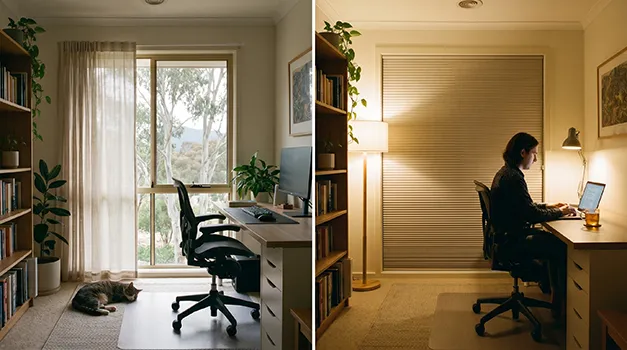
The WFH Reality: What It's Like Before and After Sheers

The Science: Why Diffused Light Beats Direct Light for Screen Work
Direct sunlight can have a luminance exceeding 100,000 lux at the surface. A typical modern monitor is calibrated to display at around 100 to 300 nits (a much lower unit). When direct sun hits your desk or wall near your monitor, the luminance contrast ratio between them becomes extreme, and that’s the glare your eyes are fighting.
Sheers typically reduce light transmission to 10%-30% of total incoming light, depending on the weave density. But critically, they also shift that light from directional to diffused. The luminance spike disappears. Your room retains plenty of brightness (far more than a pulled-down blockout), but the contrast is smoothed out.
This is also why the time on screen feels less exhausting. Eye fatigue from glare is cumulative. Solving it with the right window treatment isn’t just a comfort upgrade. It’s a cognitive one.
Solution Breakdown: Sheers vs. Your Other Options
Here’s how the main window covering options compare for a home office in Canberra:
Glare Control (Day)
Poor (open) / Total (closed)
None (open) / Total (closed)
Moderate (light filtering options)
Excellent (diffuses without blocking)
Natural Light Preserved
No – binary open/closed
Video Call Background
Reasonable
Privacy During Day
Open = no privacy
Yes – sheer fabric obscures without blocking
Aesthetic
Elegant, modern, works with any style
Aurora Recommendation
Best for night insulation
Best for night insulation
Here’s a handy tip: Sheers and honeycomb blinds both have their own strengths. If your home office gets a bit chilly in winter, you can enjoy the best of both by layering them: a sheer for those bright, sunlit days, and a honeycomb or blockout for warm, cosy nights. It’s a simple way to keep your space comfortable, no matter the hour.
Day vs. Night: The Home Office Framework
Morning (7am to 12pm)
Afternoon (12pm to 4pm)
Softer light but still direct on west-facing rooms
Sheer partially drawn
Evening (4pm onward)
What Works Best in Canberra Home Offices?
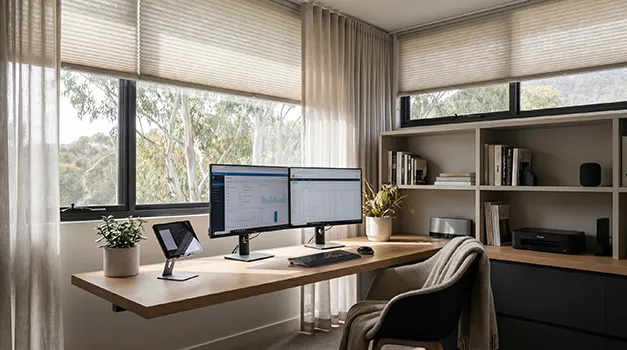
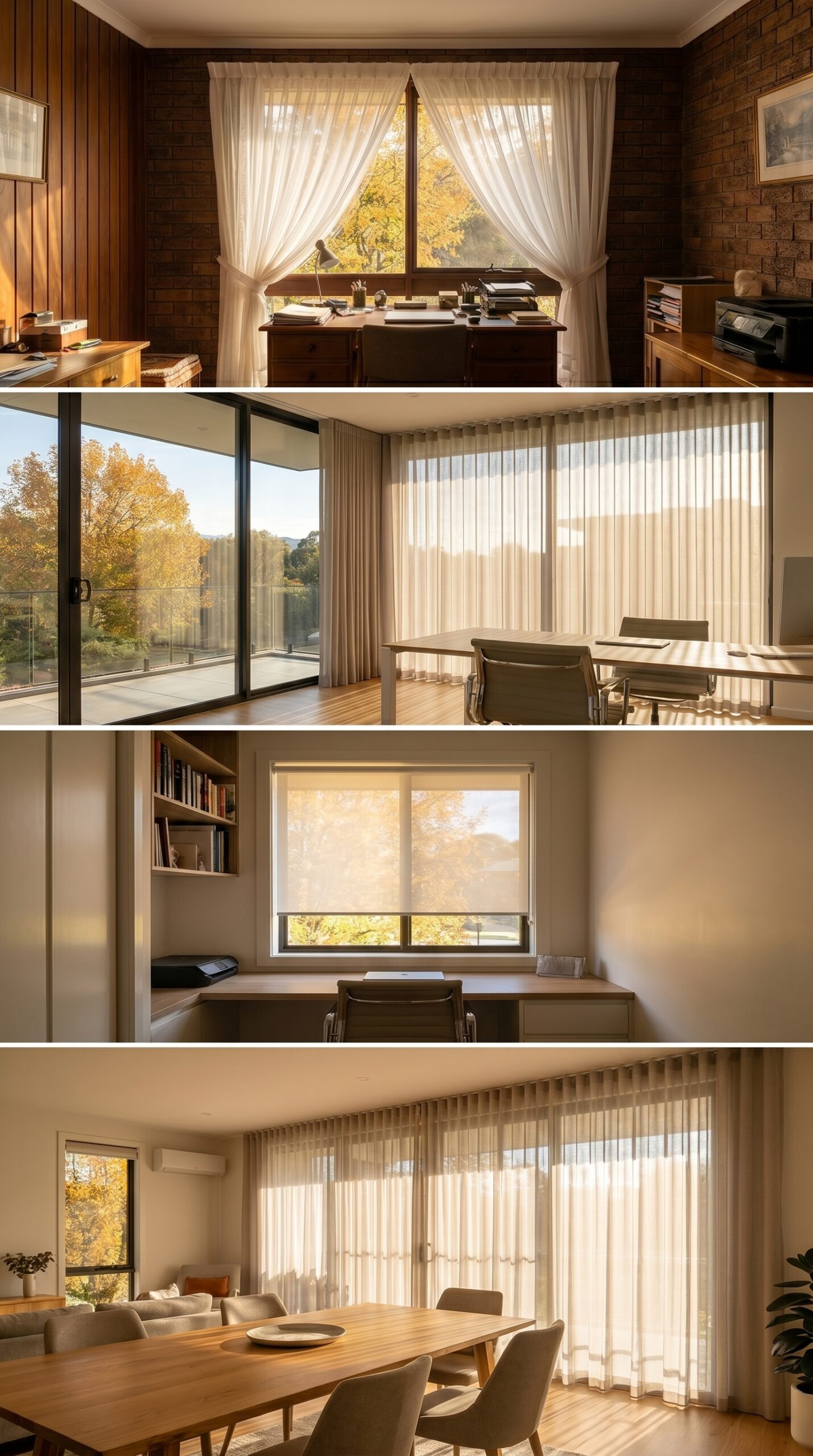
Best for east-facing home offices (Inner North, Ainslie, Braddon): A sheer curtain on a double track, paired with a honeycomb blind on the window recess. The sheer handles the morning sun from about 7:30am onward. The honeycomb seals the room at night.
Best for north-facing study rooms (Griffith, Narrabundah, Red Hill): A full-length sheer curtain that covers the entire window wall. North-facing rooms receive direct sun for most of the day in autumn, so coverage matters more than precision control.
Best for home offices in newer builds (Molonglo Valley, Wright, Whitlam): These homes often have large-format glazing. An Aurora Sheer blind, which uses a structured vane system rather than hanging fabric, gives a cleaner look that suits contemporary interiors and works perfectly for large windows.
Best for older ACT homes (1970s to 1990s brick veneer, Weston Creek, Chapman, Macquarie): Traditional sheer curtains on a rod or track. These rooms tend to have standard double-hung windows, and a classic sheer hangs beautifully and performs exactly as described. The Aurora sheer curtain range includes fabric weights that work for both light control and aesthetics in these older homes.
Best for small home offices or studies: Aurora Sheer blinds (the structured vane blind, not a curtain) fit neatly inside a window recess and are a sleek, low-profile option when space is tight.
The Mistake Most Canberra WFH Workers Make
The most common approach is a roller blind in the “light filtering” option pulled halfway down to block direct sun. It sort of works. But light-filtering fabric on a roller blind still transmits light in a relatively directional way, and the sharp blind edge creates a strong horizontal contrast line that can itself become a visual distraction.
It also doesn’t address what’s happening at the sides. Standard roller blinds leave gaps at the edges, especially in older window frames. In a home office, that gap lets in a thin blade of direct sun that tracks across your wall as the morning progresses. That’s not a minor issue. It creates a moving bright stripe in your peripheral vision all morning.
A full-width sheer curtain or an Aurora Sheer blind that covers the full window width solves this completely.
We see this all the time during our friendly in-home consultations in Barton, Deakin, and around the Parliamentary Triangle – lovely homes with roller blinds pulled to all sorts of heights, everyone trying to find that perfect balance, but not quite getting there.
Common Questions & Concerns
Is a sheer going to look too “curtain-y” in my modern home office? Not if you choose the right product. Aurora Sheer blinds use a structured vane system that looks more like a precision blind than a traditional hanging curtain. Clean, contemporary, and completely appropriate in a modern study.
Worried that sheers might let people see in during the day? Rest assured, sheers offer wonderful daytime privacy. When it’s brighter outside than in, the fabric gently blurs your silhouette and keeps your space private. In the evenings, pair them with a honeycomb or blockout for that extra layer of warmth and cosiness.
I work odd hours. What about nighttime glare from outdoor artificial light? That’s a different problem. For night-time work, the solution flips: you want a blockout or honeycomb closed fully to prevent interior light reflecting off the glass back onto your screen. Your sheer alone won’t help there. Another reason the two-layer system works so well for serious WFH setups.
Book Before the Cold Locks In
Canberra’s first frost window is closing fast. If you’ve been putting off sorting your home office, this is the practical moment to do it.
Screen glare tends to get trickier as the autumn sun sits lower each week. And by June, with heaters humming, you’ll want windows that keep things cosy as well as bright.
We’d love to help make your space more comfortable. Our friendly consultants offer a free, no-obligation measure and quote anywhere in Canberra. We’ll come to your home office, take a look at your windows, and recommend just the right solution for you.
Frequently Asked Questions
A sheer curtain or sheer blind diffuses light across the entire window width, giving you even, soft light throughout the room. A light-filtering roller blind transmits light more directly and often leaves edge gaps in older window frames, allowing thin blades of sunlight through. For screen work, sheers generally perform better.