
The Canberra Heat Leak:
Why 40% of Your Heating Bill is Flying Out the Window
Why Your Canberra Home Still Feels Cold in Autumn
It’s a familiar Canberra moment. You wake up to a crisp autumn morning, step out of bed, and feel that instant chill. You turn the heater on, maybe even increase the temperature… but the room still doesn’t feel warm.
The air feels uneven. Cold near the windows. Slightly warmer near the heater.
You’re not imagining it. And you’re not alone. Thousands of Canberra homeowners deal with exactly this every year – spending more on heating bills while still feeling like their home can’t quite hold the warmth they’re paying for. The frustrating truth is that the problem usually isn’t your heater at all.
Why Canberra Homes Struggle to Retain Heat
Canberra isn’t just cold. It’s unpredictable.
You’re dealing with:
- Near-freezing mornings
- Mild, sunny afternoons
- Rapid temperature drops after sunset
That kind of swing – sometimes 15 to 20 degrees within a single day – puts a lot of stress on a home that wasn’t designed with serious thermal performance in mind. Most houses in Canberra were built with comfort as an afterthought, and standard glazing, standard curtains, and standard blinds simply weren’t made to handle what Canberra throws at them.
Cold Mornings and Rapid Temperature Drops
That constant fluctuation makes it harder for homes to hold onto heat. Even if your home warms up during the day, it loses that warmth quickly at night.
By the time you’re sitting down to dinner, the warmth you built up in the afternoon is already seeping out through your windows. Glass is a notoriously poor insulator – it conducts heat away from your home far faster than your walls, your ceiling, or your floor. In a typical Canberra home, windows can account for up to 40% of total heat loss during the cooler months.
Why Heating Alone Isn’t Enough
It makes sense on the surface – if the room feels cold, add more heat. But it’s like trying to fill a leaky bucket.
No matter how much warm air your heater produces, if it’s escaping through your windows faster than you can replace it, you’re fighting an uphill battle. You end up paying more on your energy bill, putting extra wear on your heating system, and still sitting on the couch with cold feet.
The real fix isn’t more heat. It’s keeping the heat you already have inside the room where it belongs.
Why Glass Is a Poor Insulator
(And What It Means for Your Canberra Home)
If you’ve ever sat near a window on a July night in Canberra, you’ve felt it – that distinct, icy “chill” radiating off the glass. Even with the heater cranked up, the area near your windows feels like a different climate zone.
Here’s where things get interesting. Glass might look solid, but thermally, it’s one of the weakest parts of your home.
The Weak Link in the Building Envelope
Think about what your home is made of – brick walls, insulated ceilings, and carpeted floors. Every one of those materials has been chosen or treated to slow the movement of heat. Glass hasn’t. It’s essentially a dense, amorphous solid that conducts thermal energy almost as freely as it lets light through.
To put it in perspective, let’s look at the numbers:
- A standard single-glazed window has a metric R-value (insulating value) of around 0.17.
- A well-insulated wall in a modern Canberra home sits somewhere between R2.0 and R4.0.
That’s not a small gap – your window is the weakest point in the entire building envelope by a wide margin. In Canberra, where overnight temperatures regularly dip to 2 or 3 degrees (and often below zero), that weakness matters enormously.
How Heat Escapes Through Windows
Heat is a restless traveler; it naturally moves toward colder surfaces. In autumn and winter, your window panes are significantly colder than the rest of your home. When you heat your living space, a three-step “leak” occurs:
- Warm air moves toward the glass: As the air near the window cools, it sinks, creating a vacuum that pulls more warm air toward the cold pane.
- The glass transfers that heat outside: Because glass is a high-density material without air pockets, it conducts that warmth straight through to the outside air.
- The “Cold Influence”: This process creates a constant convection current – a loop of falling cold air – that makes your room feel drafty even if the window is shut tight.
The “40% Heat Loss” Reality
The statistics are startling: up to 40% of your home’s heating energy can escape through unprotected windows. That isn’t just a small inefficiency; it’s a major financial loss. Essentially, for every $100 you spend on heating, $40 of it might be “leaking” straight out into your garden.
Closing the Gap: How Window Furnishings Help
The good news is that you don’t always need to replace your windows to fix this. High-quality window furnishings act as a secondary thermal barrier.
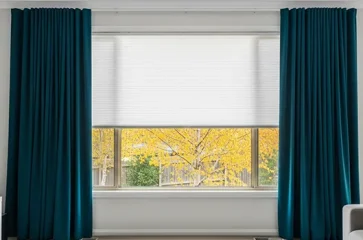
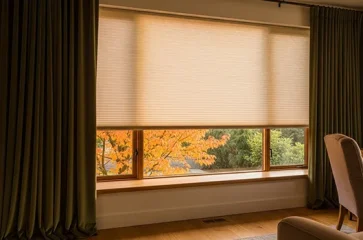
- Honeycomb (Cellular) Blinds: These are the gold standard for insulation. Their unique “cell” structure traps air in pockets, creating the same kind of thermal break you’d find in a high-end insulated wall.
- Heavy Timber Shutters: Wood is a natural insulator. Closing shutters at night adds a thick, solid layer of resistance between your room and the glass.
Where Your Heat Is Actually Escaping
It’s a common misconception that heat loss is a “glass-only” problem. In reality, a window is a complex system of joints and materials, and each one can be a potential exit point for your expensive heating.
- The Frame Edges: Think of your window frame as a thermal bridge. Aluminium frames, in particular, are excellent conductors of heat. Without a “thermal break,” the frame itself pulls warmth from your indoor air and radiates it directly to the outside world.
- The “Invisible” Gaps: Even in well-built Canberra homes, the settling of the house can create hairline fractures between the window architrave and the wall. These tiny fissures act like a vacuum, sucking warm air out while pulling a steady stream of icy Canberra air in.
- Poorly Fitted Coverings: This is the most overlooked factor. If a blind has a 20mm gap at the sides, or a curtain sits 5cm off the floor, you aren’t just losing a little bit of heat – you’re allowing a “convection loop” to form. The air behind the covering cools down, sinks to the floor, and pulls more warm air in from the top to be cooled.
The Draft You Can’t See
That subtle “chill” you feel when walking past a window isn’t always a physical breeze coming through a crack. Often, it is Radiant Heat Loss.
Because your body is warmer than the glass, you actually “radiate” your own body heat toward the cold window surface. This is why you can feel cold even if the thermostat says 22°C. Furthermore, as the air in the room touches the cold glass, it becomes denser and “falls” toward the ground. This creates a Cold Air Waterfall, a silent draft that moves across your floor and keeps your feet freezing while the rest of the room stays tepid.
Why Small Gaps Make a Big Difference
Thermal dynamics work on the principle of equalization. Heat will always move toward cold until the temperatures are balanced.
- The Pressure Factor: On a windy Canberra day, the pressure difference between the inside and outside of your home forces air through those tiny openings at a much higher rate than you’d expect.
- Cumulative Loss: A gap of just 3mm around the perimeter of a standard window is equivalent to having a hole the size of a brick in your wall. You wouldn’t leave a window cracked open in the middle of July, yet many homes effectively do exactly that because of poor seals and ill-fitting blinds.
- The Breached Barrier: A window covering’s primary job is to create a “dead air space” – a pocket of still air that acts as insulation. Even a small gap breaks that seal, allowing the air to circulate and rendering the insulation properties of the fabric almost useless.
The "Chimney Effect": Why Thin Curtains Fail
Even with the heater on, a “cycling” effect occurs. Warm air hits the cold glass, cools down instantly, and drops to the floor. This creates a constant draft of cold air moving across your feet – even if your windows are closed tight.
Pro Tip: This is why your feet often feel freezing while your head feels warm. You aren’t just losing heat; you’re creating a literal “waterfall” of cold air inside your living room.
Why Basic Curtains or Blinds Aren’t Enough
The Problem with Single-Layer Coverings
Standard blinds and curtains are almost always light-focused, not insulation-focused. If your window coverings are single-layer, they are likely failing you in three specific ways:
- Zero Thermal Resistance: A thin fabric or single-cell blind has a negligible “R-value” (the measure of thermal resistance). It might stop a glare, but heat passes through it via conduction almost instantly.
- The “Chimney Effect”: Because basic blinds often sit loosely against the window, warm air from your heater flows behind the fabric, hits the freezing glass, cools down, and sinks. This creates a constant cycle of cold drafts—even with the windows closed.
- Lack of a “Still Air” Pocket: Effective insulation requires trapped air. Single-layer coverings cannot create the dead-air space needed to act as a barrier between your living room and the -5°C Canberra night.
If you can feel a chill standing near your windows despite having the blinds down, you aren’t just losing heat, you’re paying to heat the outdoors. To truly stop heat loss, you need window furnishings designed to “break” the thermal bridge.
What Actually Works in Canberra Homes
The homes that stay comfortable in the ACT don’t rely on a single product or a “set and forget” mentality. In a climate where the temperature can drop from 15°C to -4°C in a matter of hours, the most effective homes utilize a dynamic system.
By treating your windows as a “thermal envelope,” you can regulate the flow of energy. This means combining hard window treatments (like shutters or honeycomb blinds) with soft treatments (like heavy drapes) to create multiple barriers against the Canberra chill.
Day vs Night Heat Control
In Canberra, your window strategy must change with the sun. If you leave your curtains closed all day, you miss out on free solar heating; if you leave them open at night, you lose that heat instantly to the freezing night air.
During the day (The Harvesting Phase):
- Harness Passive Solar: Open your north-facing curtains completely to allow sunlight to hit your floor and walls. This natural warmth builds up “thermal mass” inside your home.
- Manage Glare: Use sheer curtains or “screen” blinds to allow light in while protecting your furniture from UV damage, without blocking the sun’s heat.
At night (The Preservation Phase):
- The Sunset Rule: Close your window furnishings as soon as the sun goes down to “seal” the warmth inside.
- Eliminate Drafts: Ensure your night-time layers cover the entire window archive, including the sides and the top, to prevent cold air from “leaking” into the room.
Why Layering Improves Insulation
Think of layering your windows like wearing a puffer jacket over a wool sweater. One layer provides some protection, but the combination creates the ultimate thermal barrier.
1. Trapped Air (The “Dead Air” Space)
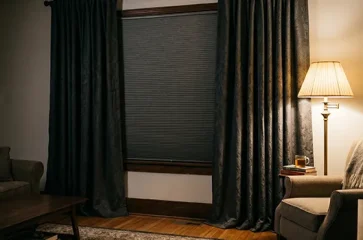
When you install a honeycomb blind inside the window frame and a heavy floor-to-ceiling curtain over the top, you create a pocket of “still” or “dead” air. This air acts as a powerful insulator because heat struggles to move through a non-moving medium.
2. Slowing Heat Transfer
Heat always moves toward the cold. On a winter night, the heat in your living room is trying to escape to the frozen garden outside. Layering forces that heat to pass through multiple materials and air gaps, significantly slowing down the rate of loss.
3. Maintaining Indoor Temperature Longer
The primary benefit of a layered system is “thermal stability.” Instead of your heater working overtime to replace lost warmth, your home maintains a steady temperature for hours longer. This doesn’t just make your home more comfortable; it directly reduces your Canberra winter energy bills.
What You Can Do Before Winter Hits
If your home:
- Feels cold even with heating
- Has temperature differences near windows
- Or costs more to heat each year
Then this is something worth fixing now.
Before Canberra’s first frost hits.
Stop the leak before the first frost. Don’t wait until July to realize your home isn’t holding heat. Book a Free Canberra Thermal Consultation with Aurora Window Furnishings today. We’ll help you identify the “leak zones” in your home.